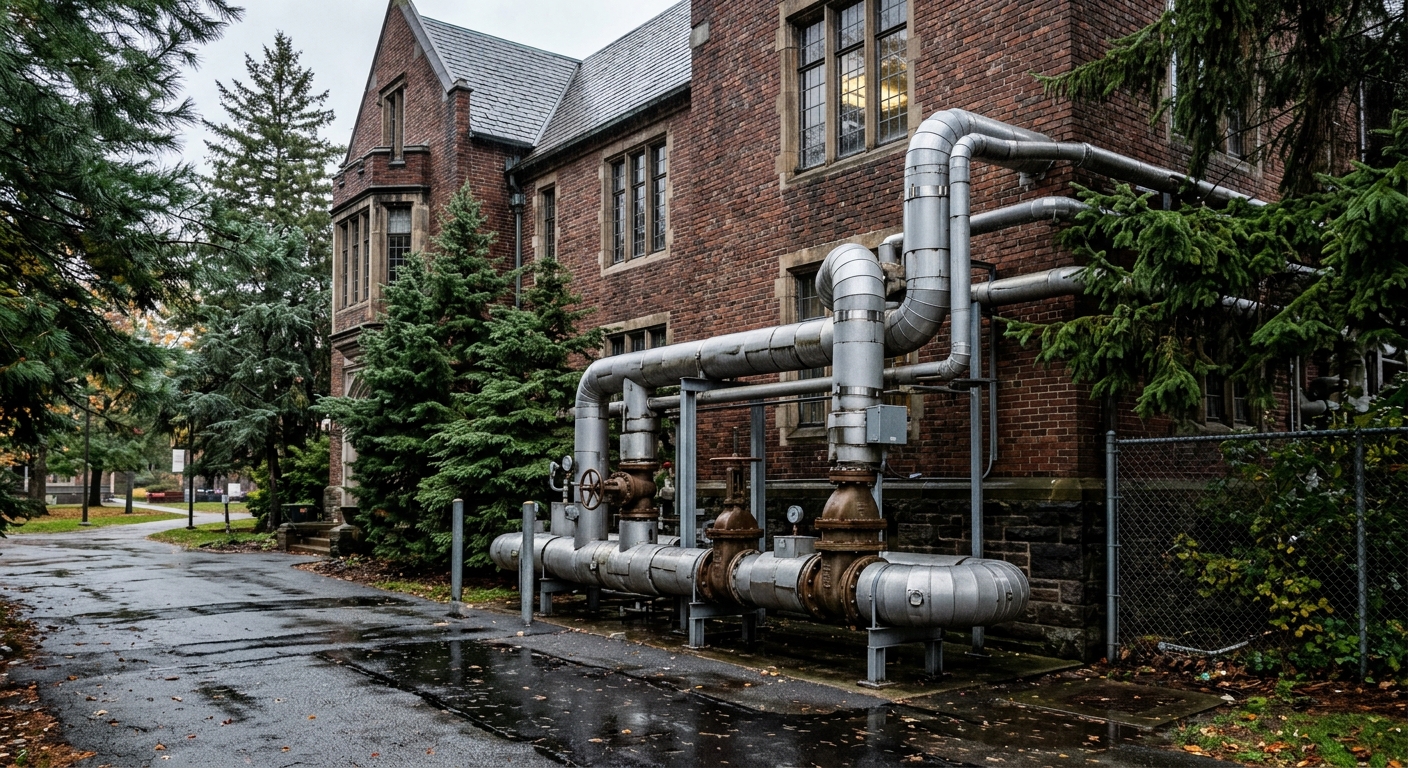
AI-generated illustration; not a photograph of the reported event.
- calendar_today October 12, 2026
Overview of the Seattle University District Energy Project
Puget Sound Energy (PSE) is moving forward with plans to develop an $18.5 million Thermal Energy Network pilot on the Seattle University campus. The goal of the project is to demonstrate the practical and commercial viability of an integrated, shared thermal loop system for district energy in an urban environment. The pilot aims to show how recycling waste heat between buildings can relieve pressure on Seattle's increasingly stressed urban energy grid.
Technology Behind the Thermal Energy Network
The core of the project is planned along the school's multilevel Broadway parking garage. It features a high-efficiency, four-pipe hydronic distribution loop powered by an industrial air-source ammonia heat pump. The system is designed to deliver 3,000 MBH of heating at 180°F and provide 285 tons of cooling at 40°F. By connecting multiple campus facilities—including Lemieux Library, Campion Hall, Loyola Building, and the Student Center—through dedicated Energy Transfer Stations, the network aims to replace traditional fossil-fuel boilers with centralized, electrified heating and cooling.
For additional reliability, two 2,000 MBH natural gas boilers will be installed as emergency backup. The above-ground utility plant structures will be placed on the southwest corner of the campus, consisting of two modular, shipping-container-sized buildings situated in the alleyway just east of the university parking garage. One module will house the heat pump compressors, hydronic distribution pumps, heat exchangers, and electrical controls, while the second will hold the backup boilers and loop-distribution equipment. Industrial condensing units will be permanently installed across the parking structure's upper deck.
Permitting and City Coordination
Building this thermal loop system requires coordination across several city departments. While the preliminary land-use assessment is complete, the construction permit application remains under review. About 1,500 feet of pipe trenching will extend into public rights-of-way along Broadway and East Columbia, necessitating Street Improvement Plan approvals from the Seattle Department of Transportation before construction permits can be issued by the Seattle Department of Construction and Inspections. The city's reviewers have outlined requirements for preserving mature street trees, managing stormwater, and maintaining traffic around existing streetcar tracks and protected bike lanes. Seattle City Light must also finalize the underground electrical designs and confirm that safety buffer zones around high-voltage lines are secured.
District Energy Developments in the Region
The Seattle University project echoes similar ambitions in the area. Just up Broadway, Seattle Central College has considered replacing its aging steam heating system with a fossil-fuel-free central power plant and an EcoDistrict. However, that initiative has faced funding challenges and now awaits its position in the 2027–2029 state budget cycle. Seattle Central had projected its new system would cost $22 million, with about $2 million already granted, including $700,000 in federal funding.
Additionally, Seattle Central's long-term vision involves replacing its Harvard at Pine parking facility with affordable housing, rather than a new energy plant.
National and Global Trends in District and Thermal Energy Networks
The pilot at Seattle University highlights a global shift toward district energy and electrified heating and cooling. In Seattle, notable examples include Amazon's campus, which uses recycled data-center waste heat in underground hydronic pipes, and the University of Washington, with a $50 million conversion of its central steam plant into a low-temperature hot-water network. Nationally, utility companies like Eversource have launched utility-run geothermal networks in Massachusetts, and New York utilities are introducing similar pilots. In cities such as Vancouver and across Scandinavia, district cooling and heating networks using shared thermal loops and large-scale heat pumps have already become standard practice.
Despite these advancements, transitioning entire residential districts to district energy in Seattle is expected to take decades, as the required infrastructure such as aging gas mains and city-wide utilities are upgraded or replaced. No specific timeline has been set for the full activation of the Seattle University pilot project.
Source: capitolhillseattle.com.