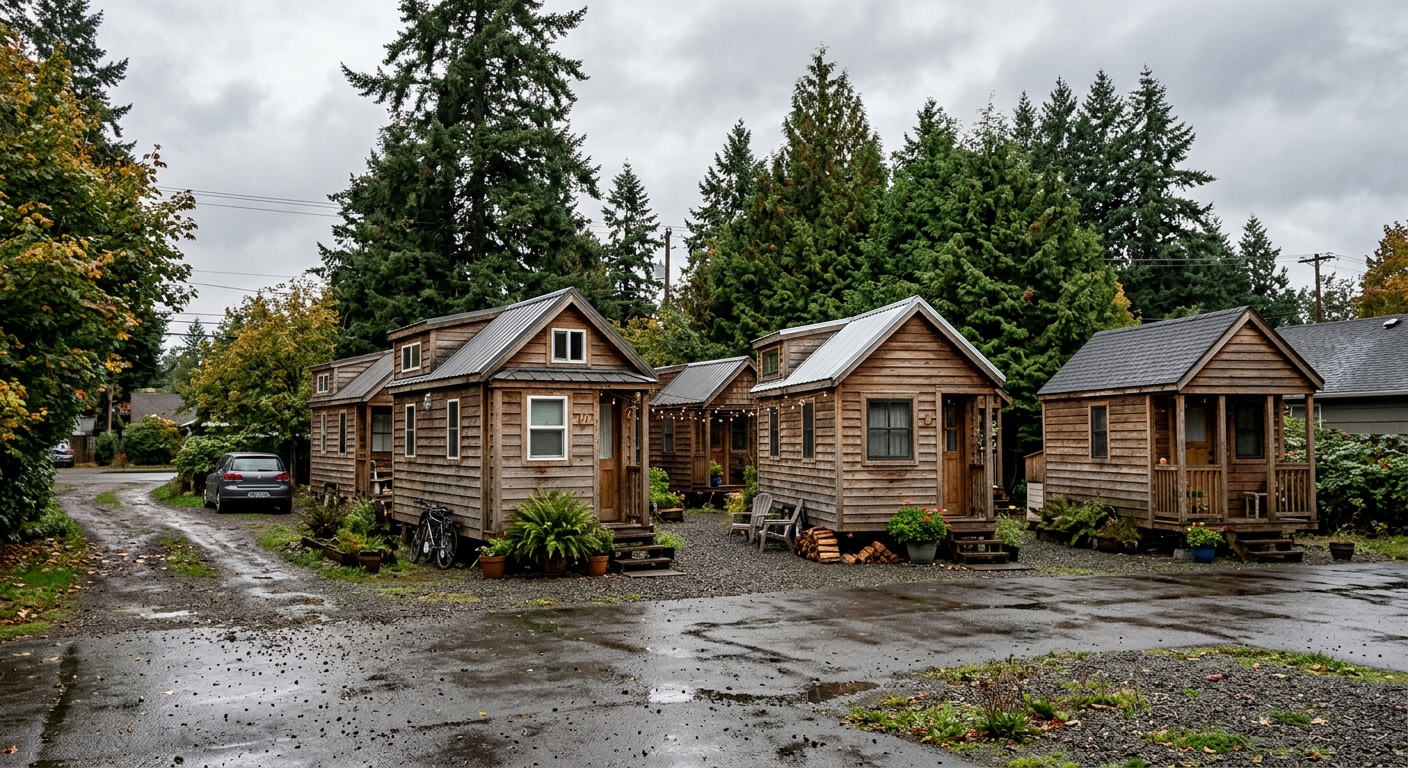
AI-generated illustration; not a photograph of the reported event.
- calendar_today November 19, 2026
King County Prioritizes Shelter Expansion in 2027 Budget
King County and the Low-Income Housing Institute (LIHI) are moving ahead with plans for a new 80-unit tiny house village in Seattle’s Central District, targeting an early 2027 opening. The Spruce Street Tiny House Village initiative is anchored by a $4 million appropriation as detailed in the county’s proposed 2026–2027 budget, with an additional county commitment totaling $5 million for shelter expansion goals.
Project Details: Spruce Street Tiny House Village
The Spruce Street Tiny House Village will be located on county-owned land at the southeast corner of the Judge Patricia H. Clark Children and Family Justice Center campus. The project is set to be developed and operated by LIHI, a nonprofit that runs 18 tiny house villages across the region. Of the 80 insulated and lockable units planned, approximately 30 will serve families with children while the remaining 50 will be allocated for singles and couples.
The facility is being designed as an enhanced shelter with amenities such as a community kitchen, shared gathering area, a children’s play space, hygiene and laundry buildings, and offices for on-site staff and case management. This approach aims to provide a supportive environment for residents as they transition from homelessness to permanent housing.
Broader Shelter and Housing Initiatives
County Executive Girmay Zahilay’s broader supplemental budget package seeks to create 500 new housing and shelter units within 500 days. The Spruce Street project is a centerpiece of this initiative and follows similar efforts such as the recent opening of LIHI’s Belmont Village in Capitol Hill, a $1.1 million facility with 31 shelter homes destined to become permanent supportive housing in partnership with the Downtown Emergency Service Center.
The city’s shelter expansion is also reflected in Mayor Katie Wilson’s “Shelter Acceleration” plan, approved by the Seattle City Council in spring 2026. The plan increased resident limits at transitional encampments and allowed for larger interim-use villages. However, shelter goals for 2027 have been moderated, with 960 beds to serve an estimated 1,750 people annually across facilities established in 2026 and eight new sites planned for 2027.
Focus on the Central District
The Central District has a longstanding history of hosting transitional shelter villages. Current sites include True Hope Village, T.C. Spirit Village, and Nickelsville Central District. The neighborhood was also the site of Seattle’s first officially sanctioned tiny house village, established in 2015, which has since made way for new permanent supportive housing projects.
The addition of the Spruce Street Tiny House Village will utilize vacant county land adjacent to the youth justice center. This area has faced persistent public safety challenges, and local officials have identified the need for effective shelter options and coordinated outreach efforts.
Community Engagement and Next Steps
Community outreach is underway, with King County and LIHI representatives presenting plans at the Squire Park Community Council in October. Final funding is pending King County Council approval, with a decision expected by November 24.
Construction and site preparation for the Spruce Street Tiny House Village will begin following budget approval, aiming for an early 2027 opening. The project is part of King County’s commitment to shelter capacity growth, using surplus property to address homelessness through evidence-based transitional shelter models.
LIHI's Model and Future Prospects
LIHI has stated that its tiny house village model offers a bridge from street homelessness to permanent housing. At their existing sites, more than half of households exiting in 2025 transitioned to permanent homes, assisted by on-site case managers providing support with employment, health services, and housing navigation.
Related coverage
Source: capitolhillseattle.com.