- calendar_today August 10, 2025
Technology Sector: Innovation Amid Policy Pressure
Washington’s renowned technology sector—home to companies like Microsoft, Amazon, and T-Mobile—remains a dominant driver of economic growth in 2025. However, the landscape has grown increasingly complex.
While private-sector research and development remains strong—making up 98.6% of total R&D spending in the state—public investment has lagged, resulting in a 23% drop in patent filings over the past five years (GeekWire, Feb 2025). Analysts warn that without a better balance of public-private support, the long-term competitiveness of Washington’s innovation ecosystem could weaken.
Adding to the challenge, the state faces a projected $16 billion budget shortfall that has already led to proposed tax increases on employers—including those in tech (GeekWire, May 2025). While major companies may absorb the impact, smaller startups and mid-tier suppliers could feel the squeeze more acutely.
Despite these hurdles, the sector continues to attract talent and capital. Amazon recently opened a new robotics R&D center in Bellevue, and Microsoft announced an expansion of its AI division, signaling continued confidence in the region’s tech capacity—even under policy strain.
Agriculture: A Trade-Dependent Sector Faces Headwinds
Agriculture has long been one of Washington State’s most export-reliant industries. In 2024, Washington exported over $7.6 billion in food and agricultural products, including apples, wheat, dairy, and potatoes (WA Dept. of Agriculture).
In 2025, however, global trade tensions are squeezing these numbers. New retaliatory tariffs—such as India’s 20% duty on U.S. apples—have disrupted key markets, particularly for growers in Central and Eastern Washington (Washington State Standard, April 2025).
Growers have reported declining export orders and fluctuating contract prices. “We used to rely on stable bulk orders from Asia and the Middle East. Now, we’re calling every distributor we know,” said a Yakima Valley orchard manager.
To adapt, many farms are exploring diversification—shifting part of their acreage to crops less vulnerable to tariff retaliation. State-level programs are encouraging value-added agriculture and local food systems to reduce dependence on export-heavy models.
Tourism: Climbing, but Still Recovering
Tourism, the fourth-largest industry in Washington, is rebounding, though progress is uneven. In 2024, visitor spending reached $25.1 billion, a 5.3% increase over the previous year—yet still 5% below 2019 levels when adjusted for inflation (State of WA Tourism, 2025).
The industry’s recovery has been bolstered by increased domestic travel and early preparations for the 2026 FIFA World Cup, set to bring international attention to Seattle. However, inflation and higher import costs have made everything from hotel construction to restaurant ingredients more expensive.
To stimulate growth, the Washington State Legislature allocated $3 million in tourism promotion funding for 2025–2026 and launched a $1 million grant program to assist local marketing organizations (Choose Washington, 2025).
With international tourism still below pre-pandemic highs, businesses are focusing more heavily on regional campaigns and local experience packages—from Columbia Gorge wine tours to Olympic Peninsula eco-tourism.
Trade Exposure and Economic Strategy
Washington’s exposure to global markets is unusually high: more than 40% of jobs in the state are tied to trade. This makes the economy particularly vulnerable to tariffs and global disruptions—whether they stem from U.S. policies or foreign retaliation.
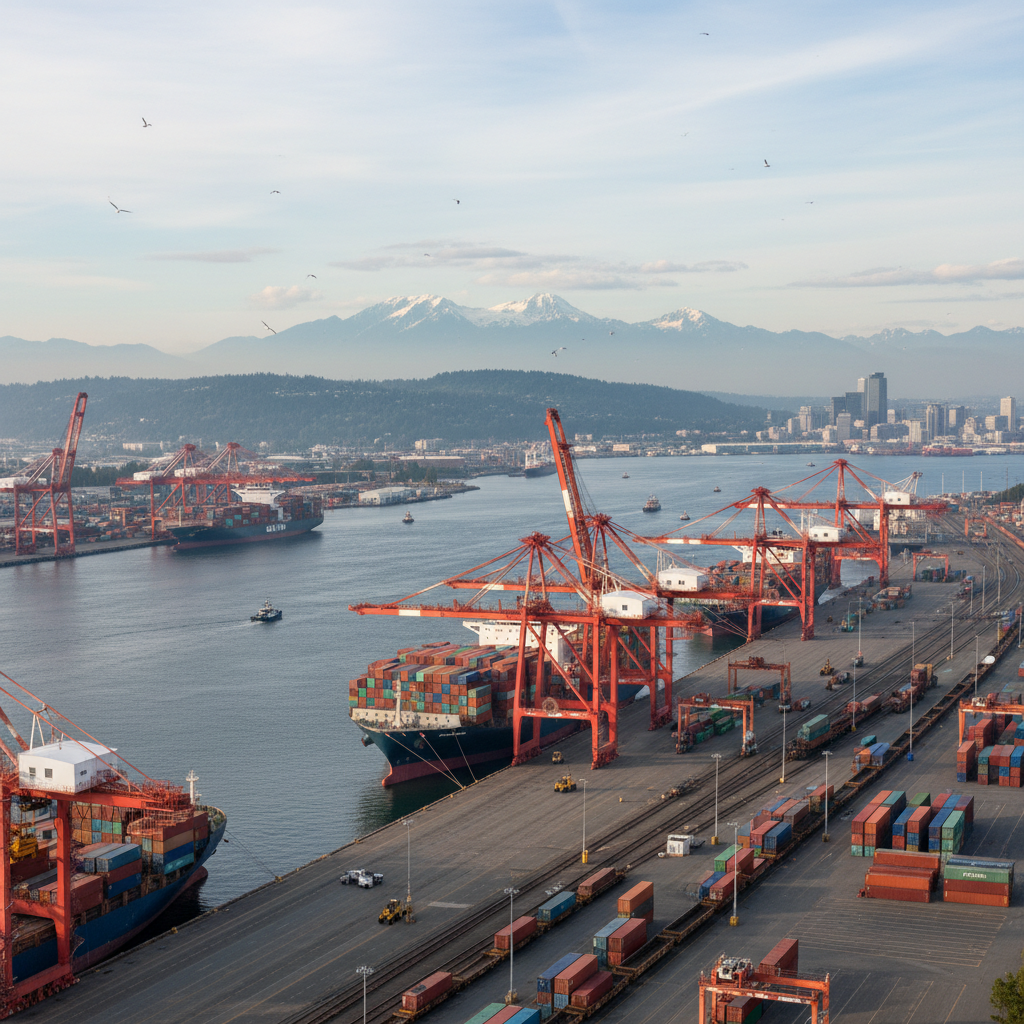
The Port of Seattle and Port of Tacoma, critical arteries for trade with Asia, have already reported a 6.8% drop in container volumes in Q1 2025, partly due to reduced Chinese imports and new regulatory inspections slowing traffic.
Meanwhile, small and medium-sized manufacturers who rely on foreign components are scrambling to rework supply chains. “We’re trying to source closer to home, but it takes time,” said the COO of a mid-sized electronics supplier in Everett. “And local isn’t always cheaper.”
Employment Trends and Sectoral Shifts
Washington’s unemployment rate held steady at 4.3% in April 2025, slightly above the national average but within healthy margins. Still, sectoral shifts are underway.
- The manufacturing sector—especially aerospace and electronics—has seen modest job losses, largely tied to reduced export demand.
- Hospitality and travel services are gaining momentum again, with hiring rising ahead of summer and World Cup preparations.
- Construction, particularly residential and public infrastructure, is facing mixed signals. Labor shortages persist, but higher material costs due to tariffs are delaying some projects.
In King, Pierce, and Spokane counties, job training programs are being accelerated to reskill workers from disrupted sectors into those showing more stability, such as logistics, healthcare, and green energy.
Local Resilience, Global Risk
While Washington faces undeniable pressure from evolving trade policy and global uncertainty, the state also possesses key strengths—an educated workforce, a thriving startup ecosystem, robust ports, and strategic location in the Pacific Northwest.
Policy experts stress the importance of cross-sector partnerships. “We can’t just wait for tariffs to go away. We need proactive strategies—local sourcing, workforce investment, and innovation support—to stay competitive,” said an economic analyst at the University of Washington.
Investors are watching closely, particularly in areas like clean tech, agriculture tech, regional tourism infrastructure, and e-commerce logistics. With resilience as the new growth metric, Washington is recalibrating—not retreating.