- calendar_today August 21, 2025
.
U.S. President Donald Trump on Monday said the country will admit 600,000 Chinese students into the United States to study at American colleges despite the increasingly heated tariff standoff with China.
The president, speaking from the White House, said academic exchange was important and that the U.S. will continue to apply economic pressure on China by implementing sweeping tariffs and making “very strong” threats of more to come.
“We’re going to allow their students to come in,” Trump said during a press conference with reporters. “We’re going to allow a lot of students to come in, 600,000 students. That’s very important. But we’re going to get along with China.”
China responded to Trump’s tariff announcement earlier this year by slapping its own 125 percent tariff on U.S. exports, and Trump, in turn, has raised the possibility of a 200 percent tariff on other Chinese goods, namely magnets, in the past week.
“China, very intelligently, went and they sort of took a monopoly on the world’s magnets,” Trump said on Monday, before asking when he would be able to buy U.S. magnets. “It’ll probably take us a year to have them.”
The long-running spat between Washington and Beijing centers on Washington’s concerns that China is seeking to dominate advanced technologies such as semiconductors and aircraft manufacturing through targeted industrial policies and subsidies. Trump’s administration has spent months ratcheting up economic pressure on China with tariffs that Washington says will encourage more manufacturing in the U.S.
Despite negotiating teams in Geneva agreeing in May to halt further tariffs, Trump and other members of his administration have continued to signal they are looking at new punitive levies.
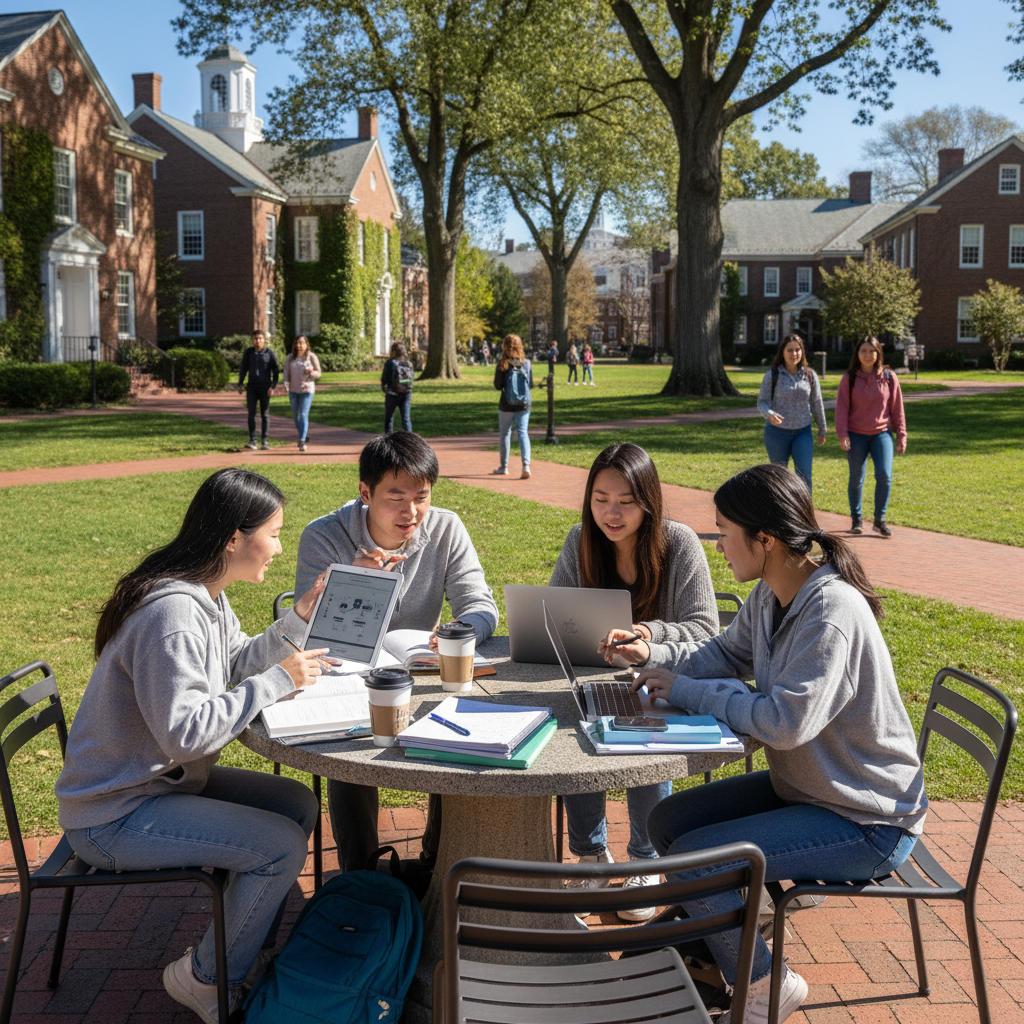
Chinese students currently in the U.S. total about 270,000, but Trump said the number will double.
“I would like to see much more student interaction, and we’ll do that,” he added. “I hear so many stories that we’re not going to allow their students. We’re going to allow their students to come in.”
The president made the remarks just before a meeting with South Korean President Lee Jae Myung, and when asked if he would be open to a similar meeting with Chinese President Xi Jinping, Trump responded by saying that he would “like to meet him this year.”
“It’s a very important relationship,” Trump said. “As you know, we’re taking a lot of money in from China because of the tariffs and the different things. It’s a very important relationship, and it’s a much better relationship economically than it was before with Biden. But he allowed that. They just took him to the cleaners.”
Trump’s earlier pledge for educational cooperation with China also came days after he said his administration would work with other countries, including China, to develop plans for processing Russian oil.
The past week has seen the Trump administration go on what appears to be a charm offensive of sorts, saying it would allow American companies to process oil stolen from Russia while sanctioning Russian banks and being “ready to deploy” troops to NATO countries.
While Monday’s announcement of allowing Chinese students into the U.S. could bring billions of dollars in tuition revenue to American colleges, it also comes after Trump and other top officials took a hardline approach to visas for Chinese nationals.
In May, Rubio said the State Department was “working on being able to aggressively revoke” visas for Chinese nationals, particularly those that were “associated with the Chinese Communist Party and its unlawful actions” or working in sensitive areas of research and technology.
The proposal drew alarm from the higher education community and prompted pushback from universities concerned about the potential loss of Chinese students.
Trump had softened his tone on the issue as early as June, telling reporters he had “always been in favor” of Chinese students studying in the U.S. On Monday, he doubled down on that assertion and pledged to more than double the number of Chinese students in the U.S.
Not everyone in Washington’s foreign policy circles has been entirely opposed to student exchanges between the U.S. and China, however. In late May, a bipartisan group of 14 U.S. senators introduced a bill to increase funding for students coming from China to study in the U.S.