- calendar_today August 13, 2025
In 2025, Washington State’s commercial real estate market is showing signs of a robust rebound, particularly in urban tech hubs and logistics corridors. Unlike states that rely heavily on traditional industries, Washington’s recovery is being fueled by its innovation economy, renewable energy expansion, and a post-pandemic rebalancing of demand across key property types. While Seattle continues to act as the state’s real estate bellwether, secondary cities like Spokane, Tacoma, and the Tri-Cities are playing a growing role in reshaping the state’s CRE footprint.
Office Sector: Stabilization in the Emerald City
Washington’s office market, particularly in Seattle and Bellevue, is finding its footing in 2025 after several years of hybrid work uncertainty. Major employers like Microsoft, Amazon, and Google have reconfigured their footprints rather than abandon them, leading to a new era of adaptive reuse and smaller, more tech-integrated office designs.
According to Kidder Mathews, Class A office space in downtown Seattle has seen rising occupancy rates since late 2024, driven by demand for collaborative hubs and ESG-compliant buildings. Vacancy rates, which peaked above 18% in 2023, have dipped closer to 14% in Q2 2025—a signal of cautious optimism among developers and investors.
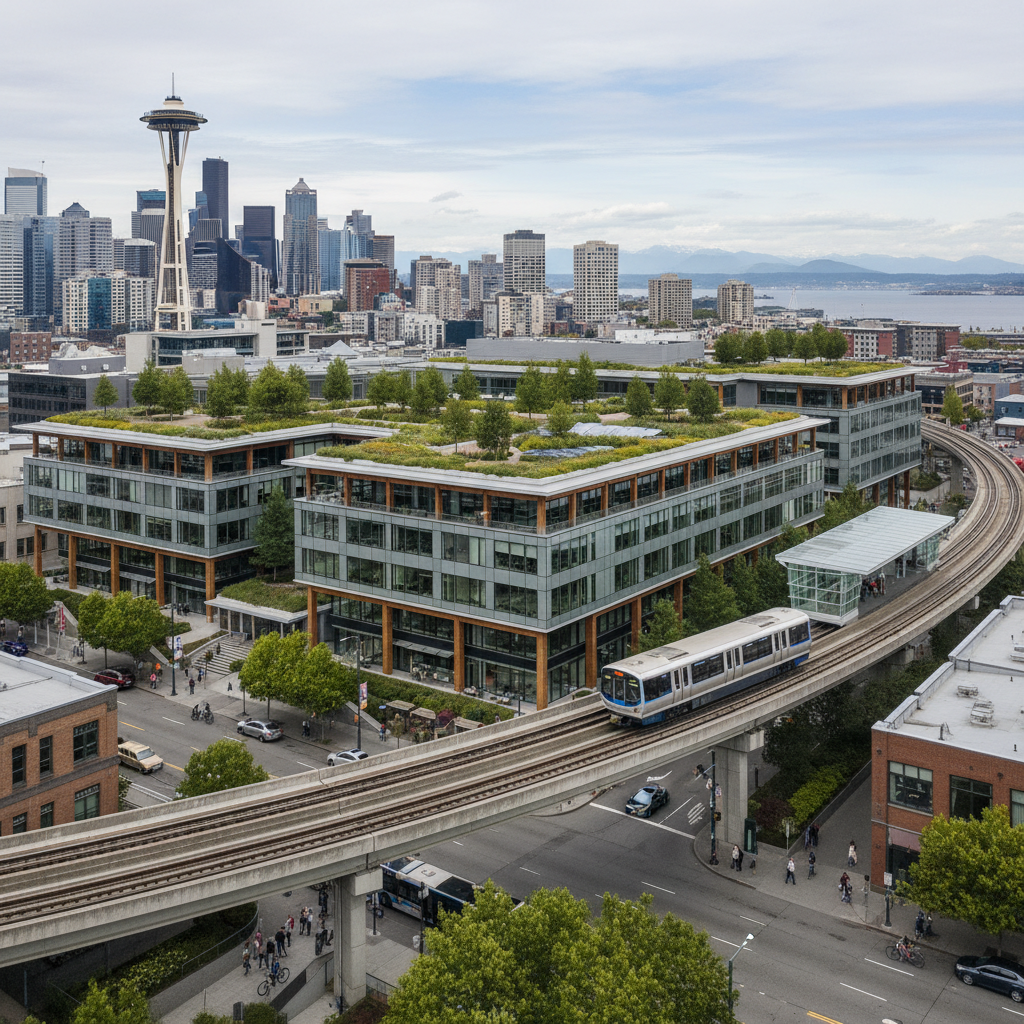
In Bellevue and Redmond, the “return to office” movement is anchored by transit-oriented developments and green-certified buildings. The opening of the East Link Light Rail extension has significantly increased leasing interest in proximity to the new stations.
Industrial & Logistics: Eastern Washington’s Rise
As e-commerce continues to fuel logistics and warehousing growth, Washington’s industrial real estate market is outperforming national averages. Amazon’s new distribution center in Pasco, part of a larger expansion across Eastern Washington, underscores the state’s strategic importance in West Coast supply chains.
Industrial vacancies remain under 4% in Spokane and Kent Valley, according to CBRE, making it one of the tightest markets in the Pacific Northwest. Developers are actively converting underutilized land near the I-90 corridor into Class A logistics parks.
The Port of Seattle’s modernization and Tacoma’s inland port expansion are also playing key roles in strengthening the state’s import/export infrastructure. These upgrades are attracting cold storage investments and sustainable warehouse designs that align with Washington’s broader climate goals.
Retail Recovery: Mixed-Use and Urban Revitalization
Retail real estate in Washington State is rebounding—selectively. In major metros like Seattle, standalone brick-and-mortar continues to struggle, but mixed-use developments combining residential, entertainment, and commercial components are gaining traction. Pike Place Market and Ballard Avenue have seen foot traffic return to near pre-pandemic levels, thanks in part to tourism rebounds and improved downtown safety measures.
Suburban retail is faring better. In cities like Spokane and Bellingham, lifestyle centers and open-air retail strips are attracting tenants in the food, wellness, and experiential categories. National chains such as Target and Trader Joe’s are expanding footprints in the Puget Sound area, signaling long-term confidence in the region’s consumer demand.
Notably, cannabis retail continues to be a niche but stable sector. Washington’s mature regulatory framework has allowed dispensaries and related businesses to expand cautiously in both urban and rural areas.
Multifamily and Live-Work Integration
Washington’s population growth remains modest but steady, led by tech talent migration and rising enrollments in universities like UW and WSU. In 2025, this is translating into continued strength in the multifamily sector, particularly in walkable, transit-friendly neighborhoods.
New apartment completions in Seattle’s Capitol Hill, Renton, and Everett are over 90% leased within six months, reflecting demand for smaller, amenity-rich units that support remote and hybrid work. Across the state, mixed-use zoning reforms—especially in Spokane and Olympia—are making it easier for developers to integrate housing with ground-floor commercial space.
In rural communities, small-scale multifamily developments are helping counteract years of housing underproduction, with support from Washington’s Housing Trust Fund and new state incentives for sustainable building materials.
Sustainability and Green Building: A Competitive Advantage
A defining trend in Washington State’s 2025 CRE market is the integration of sustainability metrics into development and investment decisions. With the passage of stricter statewide energy codes and Seattle’s benchmarking ordinances, property owners are prioritizing LEED certification, green roofs, and electrification retrofits.
Real estate investment trusts (REITs) and institutional investors are favoring assets that align with environmental, social, and governance (ESG) goals, particularly in markets with stable political and regulatory frameworks like Washington. This green momentum is positioning the state as a model for sustainable commercial real estate across the Pacific Northwest.
Challenges Ahead: Affordability and Land Constraints
Despite the positive momentum, Washington’s CRE landscape faces notable challenges. Urban affordability remains a critical issue—rents for both commercial and residential tenants have risen sharply in high-demand areas. In downtown Seattle, Class A office rents climbed 5.2% year-over-year, while industrial land prices have doubled in some King County submarkets since 2020.
Zoning limitations and community opposition to large-scale development continue to slow project approvals in places like Kirkland and Issaquah. Moreover, rising insurance premiums—especially for properties near wildfire zones in Central Washington—are beginning to impact investor risk models.
Investment Outlook: Targeting Regional Resilience
Investors looking at Washington State in 2025 are focusing on assets that combine long-term sustainability with demographic resilience. Secondary markets like Spokane Valley, Yakima, and Tri-Cities are increasingly attractive for institutional capital, offering higher cap rates and lower operating costs compared to King and Snohomish counties.
Retail-to-industrial conversions, student housing near major universities, and Class B office space retrofits are among the most active strategies in the state. Foreign direct investment, particularly from Canada and Asia, is also playing a quiet but growing role in urban real estate developments across Seattle.
Final Takeaway
Washington State’s 2025 commercial real estate rebound is shaped by more than just post-pandemic recovery—it’s being redefined by tech resilience, green infrastructure, and the emergence of regional nodes outside the I-5 corridor. While challenges remain, the state’s blend of innovation and sustainability is helping it chart a path that other states are watching closely.