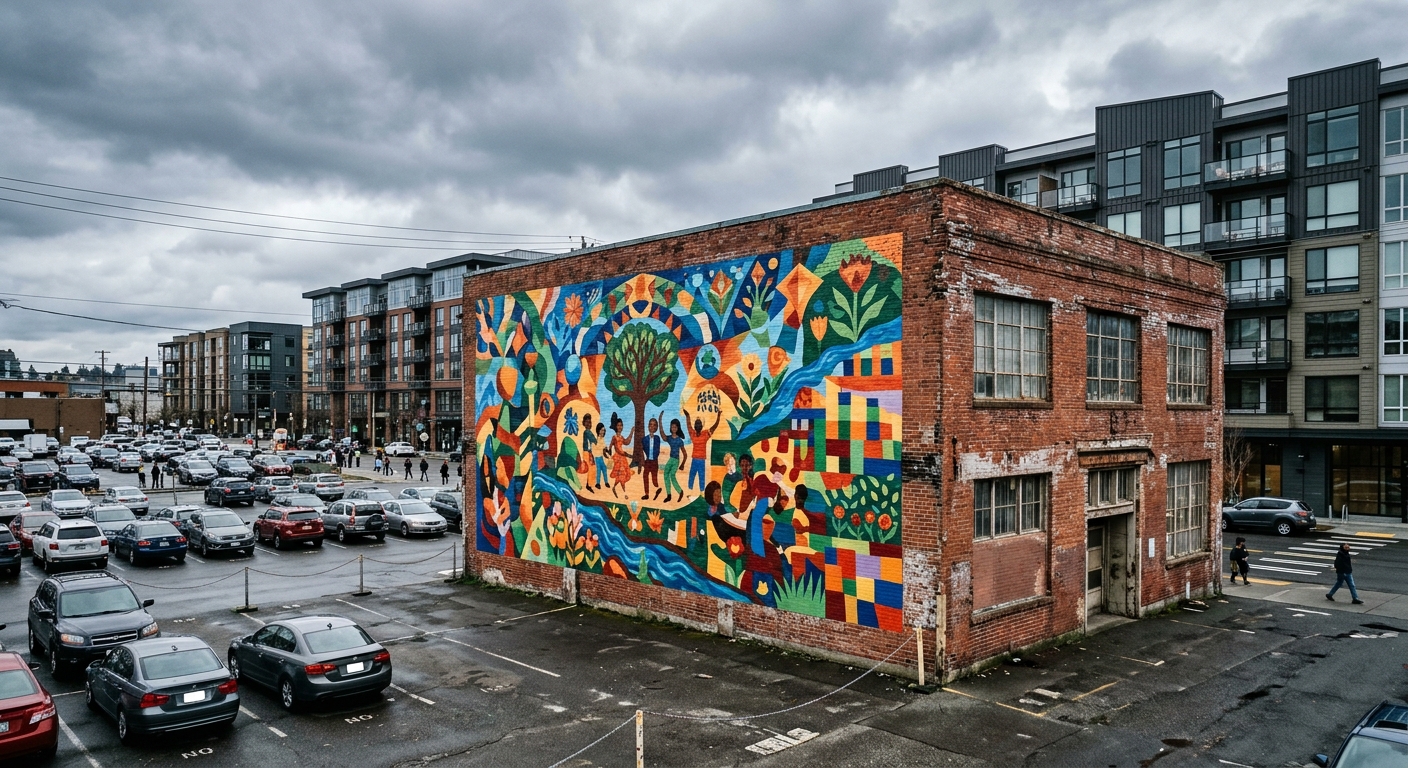
AI-generated illustration; not a photograph of the reported event.
- calendar_today November 6, 2026
A New Mural Emerges on 15th Ave E
This fall, Capitol Hill witnesses the addition of a new mural on the north side of the Key Bank building at 321 15th Ave E. Created by artist Glynn Rosenberg, the piece boldly addresses the subjects of housing insecurity and the ongoing transformation within the neighborhood. Facing a street that has seen rapid development, the mural offers a commentary on the shifting realities of life on Capitol Hill.
The Artist’s Message: Housing and Change
Glynn Rosenberg describes her mural as “a love letter” to Capitol Hill, blending past reflections with hope for the future. Rosenberg’s statement emphasizes the challenges of housing affordability in the area, noting that “people can’t afford to live in Capitol Hill anymore.” The work is deeply personal, as the artist grapples with her place in a community shaped by forces of change, progress, and development that are often beyond individual control. Rosenberg sees the mural as a utopian vision, both honoring the past and looking ahead with optimism.
The Bank That Almost Became Apartments
The mural occupies a prominent wall of the Key Bank building, a structure that plays its own part in the story of neighborhood change. In 2005, plans were in place for the bank’s property to be rezoned by the city, paving the way for a 40-foot tall mixed-use apartment building. However, the global financial crisis of 2008 halted these redevelopment plans, leaving the 1960-era bank and one of Capitol Hill’s last large surface parking lots untouched.
Had the development proceeded, the site would have manifested the very changes Rosenberg’s mural contemplates: the conversion of local landmarks to new apartments amid evolving economic and social landscapes.
Support and Collaboration
The project was made possible with support from several organizations. Key Bank notes contributions from the GSBA, King County, and Urban ArtWorks. Their involvement helped bring Rosenberg’s vision to the side of the building, contributing to a growing collection of public art in the neighborhood.
Capitol Hill’s Flourishing Urban Art Scene
Rosenberg’s mural joins a recent wave of public art and community murals on Capitol Hill, especially along and near 15th Ave E. The area now features works such as Billy Davis’s Sanctuary on the Walgreens building and a Shepard Fairey mural on the Hilltop Apartments. These installations collectively signal a vibrant chapter for urban art in the neighborhood.
Meanwhile, mixed-use apartments continue to shape the physical and social landscape of 15th Ave E, with the community awaiting even larger redevelopment projects—most notably the planned six-story redevelopment of the old QFC block. Yet for now, the Key Bank mural stands as both an artistic landmark and a reminder of Capitol Hill’s ongoing evolution.
The Future of the Mural
The fate of Rosenberg’s mural remains tied to the future of the Key Bank building itself. While many similar properties have transformed into mixed-use apartments, the bank endures for now. If redevelopment returns to the site, the mural may eventually disappear along with the building. Until then, it continues to speak to themes of housing insecurity, community resilience, and the pace of neighborhood change.
Source: capitolhillseattle.com.