- calendar_today August 18, 2025
Nvidia leads in graphics technology while researching AI’s potential to revolutionize gaming experiences. Nvidia’s powerful GPUs deliver visually stunning graphics, and the company now has an experimental G-Assist AI to offer. The tool operates locally to improve PC performance while boosting gaming experiences.
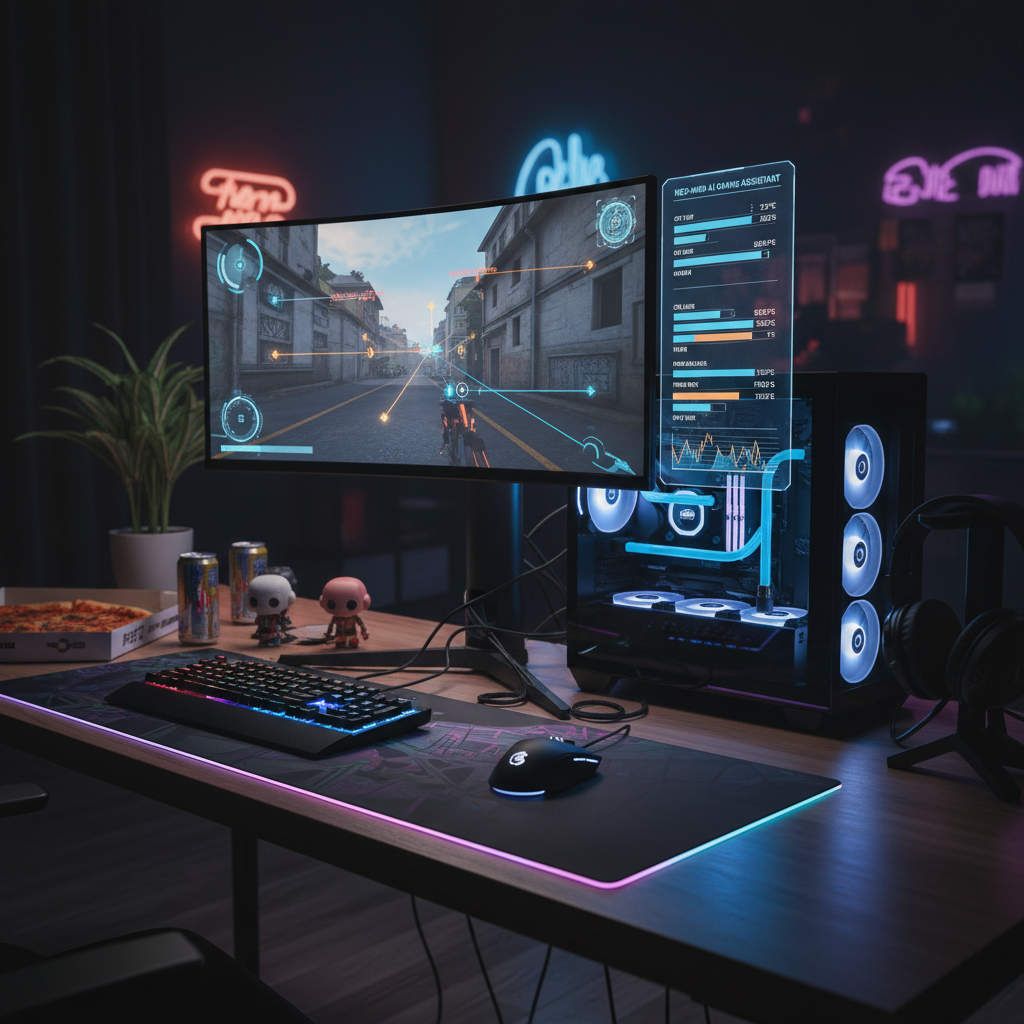
The Nvidia desktop application provides access to G-Assist as an on-screen overlay, which lets users control an AI assistant using text or voice commands to transform their interaction with hardware and software beyond basic system monitoring.
G-Assist introduces a range of intriguing capabilities. Users can inquire about general topics through questions like “What is the process behind DLSS Frame Generation work?” “, and receive informative, AI-driven responses.
The AI possesses abilities to control precise system-level configurations. G-Assist activation enables gamers to access immediate operational analyses of their systems along with dynamically created data charts. The AI system receives commands to modify game settings and switch various features on and off. G-Assist enables GPU overclocking options for performance enthusiasts and provides projections of expected performance increases.
Nvidia focuses on desktop AI performance with dedicated GPUs as “AI laptops” reshape the PC market. Nvidia’s G-Assist relies on local operation through the user’s GeForce RTX graphics card while most AI tools utilize cloud-based computing. Nvidia explains that G-Assist operates on a small language model which has been optimized specifically for local use.
Install the basic text version with 3GB storage, but add 3.5GB more for voice control features to reach a total of 6.5 GB. Nvidia’s G-Assist needs a GeForce RTX 30, 40, or 50 series graphics card with a minimum of 12GB of VRAM for proper operation. The application’s performance adjusts according to what the GPU can handle while future versions aim to add support for laptop GPUs.
The public release of the system exhibits some promising features, but does not reach the integration depth demonstrated last year when G-Assist provided direct in-game assistance. The current integration capabilities exist only for a limited number of games, Ark: Survival Evolved being one example. Through third-party plug-in support, Nvidia has expanded what G-Assist can achieve. The AI assistant can interact with devices from Logitech G, Corsair, MSI, and Nanoleaf to enable features such as modifying thermal profiles dynamically and synchronizing LED displays.
Running G-Assist on the GPU locally presents both beneficial prospects and technical difficulties. By processing data locally, users can experience better privacy protection alongside shorter response times. However, it also introduces performance considerations. When we tested the RTX 4070 GPU with G-Assist interaction, we observed a significant rise in GPU utilization. The AI response generation process, known as inference, requires substantial computational resources, which affect the performance of other tasks, especially during resource-intensive gaming sessions.
While playing Baldur’s Gate 3 at maximum settings, G-Assist processing led to a 20% decrease in frame rates. G-Assist may intensify performance bottlenecks in systems that are already functioning near their capacity limits. G-Assist functions more smoothly during non-intensive gaming scenarios, but requires a strong GPU for heavy sustained usage.
The Promise of G-Assist
G-Assist demonstrates its experimental status through its intermittent slow performance and bugs. Most users still need to adjust their system and game settings manually because this method proves more effective currently. G-Assist constitutes an essential advance in utilizing gaming PCs’ AI processing capabilities.
Future Implications
The ability to operate intensive games alongside complex AI models without interruption will become feasible as GPU technology continues to progress. At present Nvidia’s G-Assist presents a promising yet evolving view of AI-powered gaming potential while hinting at future GPU applications in user interaction and intelligence.