- calendar_today August 14, 2025
.
US electric vehicle adoption has recently hit a fresh snag. After over a year of accelerating month-over-month EV sales, the pace has begun to reverse, with declines now expected this year. Electric cars have already seen consumers balk at offerings from Genesis and Volvo, with the former now reportedly backing away from their lineup.
Worsening political headwinds have made matters worse. The Biden administration has made cuts to EV subsidies and reduced vehicle pollution rules. This has whittled down federal incentives available to buyers, although analysts and industry researchers say that the true hurdles may be more mundane and closer to home.
Home and Garage Challenges
For many Americans, the anxiety around charging and charging infrastructure is the single greatest factor deterring them from buying an EV. But a new analysis of charging by Telemetry Vice President Sam Abuelsamid has added an interesting nuance to the conversation, identifying the usage of one particular household amenity as a critical factor.
In short, a lot of EV charging still happens at home. Public fast-charging networks have been headline-grabbing, but according to Abuelsamid, AC power charging still accounts for an estimated 80 percent of all charging, with the vast majority of those chargers being in single-family homes. An NREL study found that “42% of homeowners currently park near a charging outlet that could support Level 2 (240-Volt) charging.”
That number could rise sharply, however, if homeowners were to open up more space in their garages and shift their parking habits. “Parking behavior, namely whether homeowners use a private garage for parking or storage, will likely become a key factor in EV adoption,” the report states. “90% of all houses can add a 240 V outlet near where cars could be parked.” Adding in homes where wiring to an existing outlet is possible, this could total more than 50 million homes with the potential for EV charging, up from the 31 million today.
Parking behavior changes could increase this even further, up to more than 72 million households with the potential to charge if wiring was added to an open garage or external parking spot. That total is above Telemetry’s own high-end EV adoption forecast for 2035, which puts potential EV penetration between 33 million and 57 million vehicles.
One complication: This theoretical capacity doesn’t necessarily translate into readiness. The same NREL study that identified the latent potential for charging also pointed out that 33.9 million households would need an electrical upgrade to have the power to run a level 2 charger, which typically requires at least 30 amps of power. Electrical upgrades can be minor, but the price to replace a panel and run new wiring to an external spot could easily exceed several thousand dollars.
Throwing that into the mix complicates one of the central EV narratives: the expectation that the costs of owning and operating an EV are lower than a gasoline car. Adding in the cost of charger installation to purchase prices of EVs tips the total cost of ownership quickly toward the same price range as a regular vehicle.
Parking at Home: The Apartment Owner Challenge
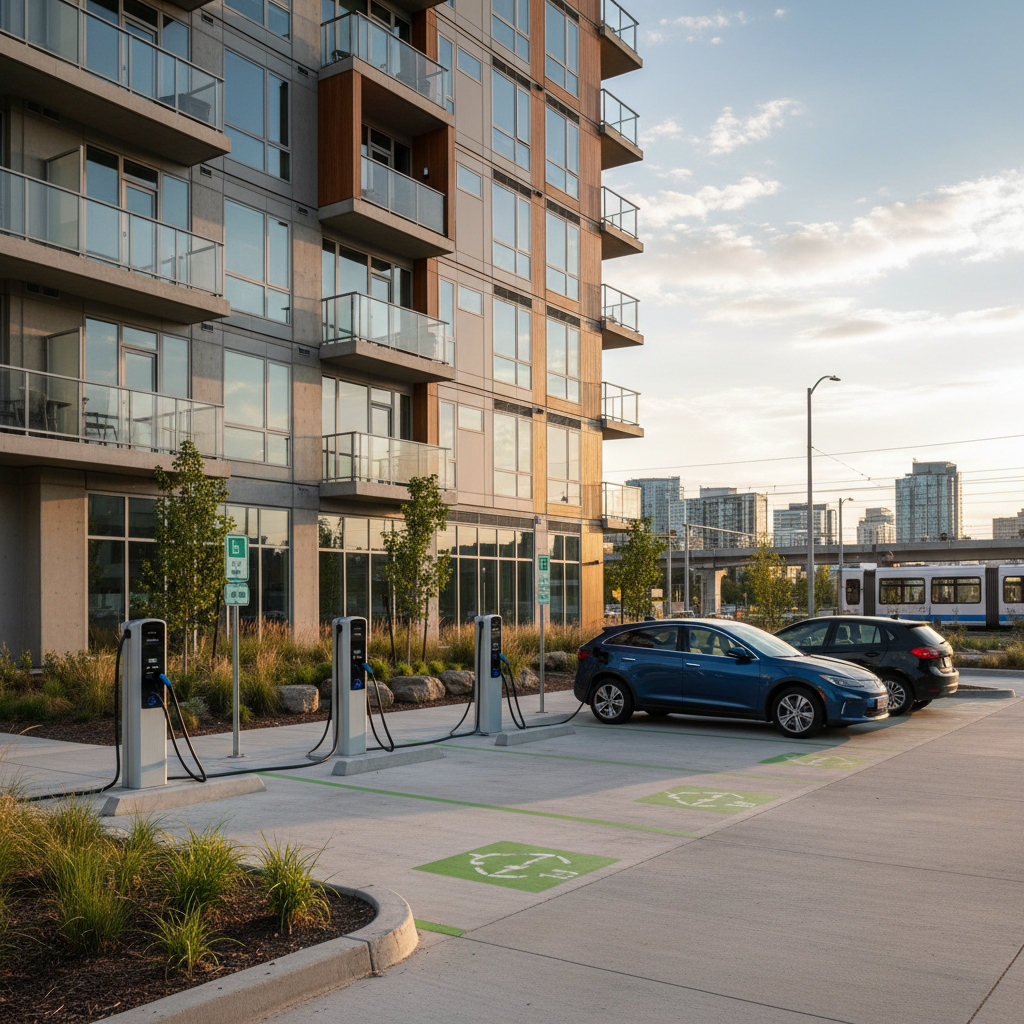
This scenario only grows more complex for the 23 percent of Americans who live in multifamily buildings like apartments, condos, and townhomes. In these homes, the EV owner can’t typically just install their own charger. Instead, they are beholden to property managers, landlords, or co-op boards for access, which are not always willing to make the investment.
The cost barrier is more acute as well. For example, a multifamily co-op may have to undergo a panel upgrade to even have the capacity to add a pair of level 2 chargers, an upgrade that can cost several million dollars. The wiring costs to access more distant spots are also higher. The owners or residents of these buildings may also be precluded from receiving local or utility subsidies to install chargers.
It’s an issue for demand in that housing sector as well. The report identifies a little over a million EV owners in multifamily housing, but only 11 percent park close enough to a potential outlet to charge. Some states are requiring that future housing developments have 20–25 percent of parking spaces be EV-ready, but even in those markets, Telemetry forecasts a low end of only 6.7 million and a high end of 11.4 million charging-capable spaces in multifamily dwellings by 2035.
Expanding the Public Charging Infrastructure
The issue is so stark that it raises the profile of public charging as a point of both necessity and contention. Public charging won’t ever replace home charging as a convenience factor, but Telemetry estimates that 11.7 million to 14.3 million EV drivers who own homes will still use public charging by 2035. An additional 7.8 million to 8.1 million EV owners in multifamily residences will need public charging, as well.
Satisfying that level of demand would require 523,000 to 586,000 DC fast chargers, along with 1.5 million to 1.6 million level 2 chargers at fixed public locations, just to meet the estimated needs. The rollout of that scale faces several substantial hurdles as well. In a separate report, Telemetry points out that power providers are already being overwhelmed with new load growth from AI data centers bidding on generation and distribution capacity. This capacity crunch is further accelerating the energy transition, but also complicates the deployment of public charging sites.
EVs still have a long way to go in the US before they overtake regular vehicles. There are a lot of homes where chargers can be installed, but too many of those garages are already full. The cost to add charging, particularly in older and more urban areas, is still too high for many potential EV owners. And even if installation is eased by policy or subsidies, the lack of owner control of parking spaces in multifamily dwellings is a major hurdle. The public charging network will be a critical component in driving US EV adoption, but the public policy debate over charging access and equity has just become more complex.